
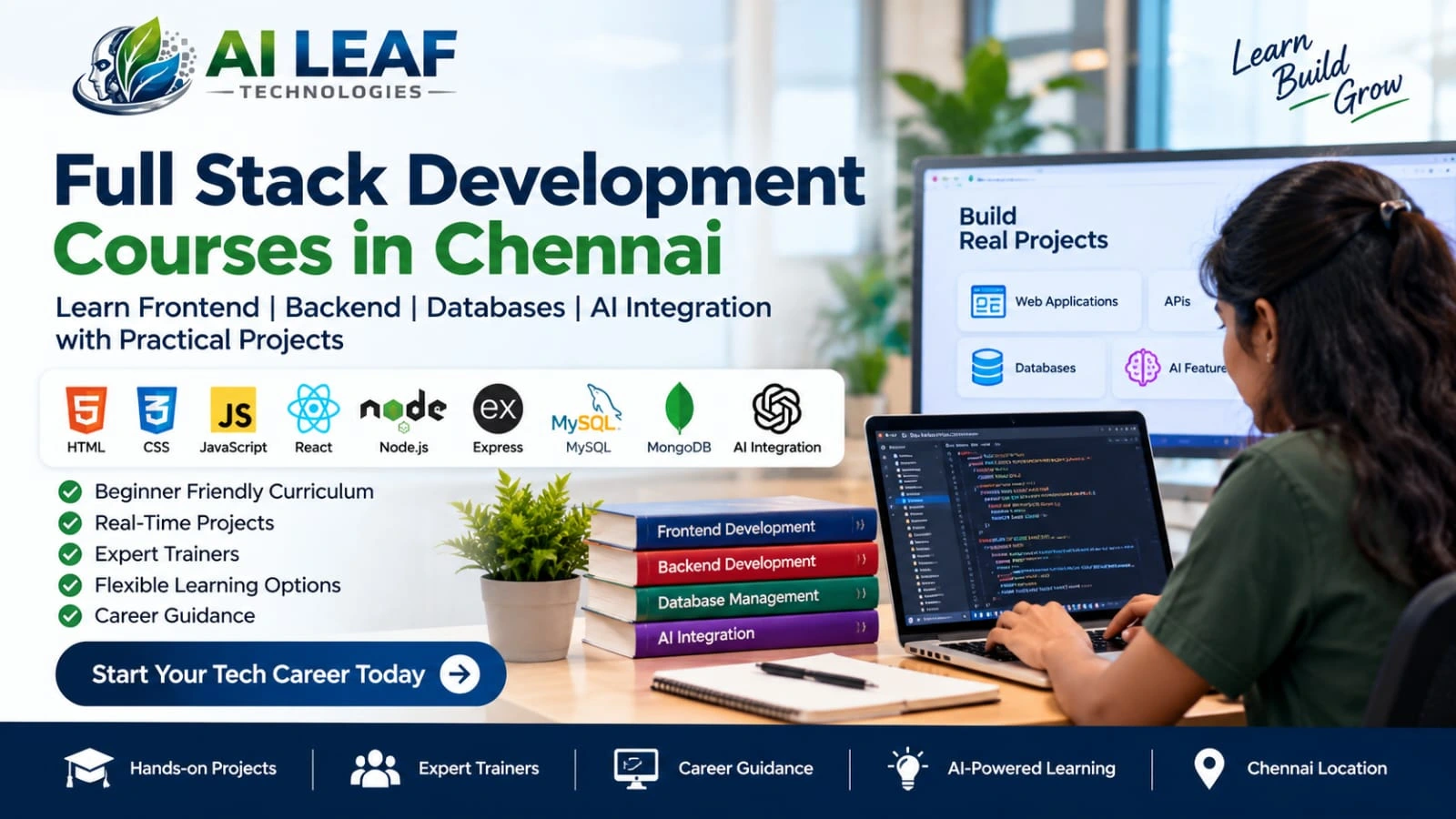
Why Are Full Stack Development Courses in Chennai a Smart Choice for Beginners?
Why Are Full Stack Development Courses in Chennai a Smart Choice for Beginners?
𝗜𝗡𝗧𝗥𝗢𝗗𝗨𝗖𝗧𝗜𝗢𝗡
Building a website involves several connected tasks, including creating the interface, processing user requests, organising stored information and making different parts of the application work together.
For beginners interested in technology, understanding these connections can be a useful step towards developing functional web applications. Full Stack Development Courses in Chennai can introduce learners to the complete development process, from designing a webpage to managing information through server-side code.
Instead of concentrating on only one part of a website, full stack development introduces both frontend and backend technologies. Learners can also explore how artificial intelligence supports selected features, such as intelligent search, content summarisation and automated assistance.
The most useful learning experience combines technical knowledge with practical projects. By writing code, testing features and correcting errors, learners can gradually understand how applications are planned, developed and maintained.
𝗪𝗛𝗔𝗧 𝗜𝗦 𝗙𝗨𝗟𝗟 𝗦𝗧𝗔𝗖𝗞 𝗗𝗘𝗩𝗘𝗟𝗢𝗣𝗠𝗘𝗡𝗧?
Full stack development involves working with the frontend and backend of a web application.
The frontend forms the interactive layer of a website, where visitors view information, navigate between sections and use features such as forms, menus and buttons. Backend development manages the logic behind those interactions, including processing requests, checking submitted information and communicating with databases.
Consider an online shopping website. The frontend displays products and allows customers to place orders. The backend processes order requests, while the database stores product details and order information.
An API connects different parts of the application and helps them exchange data. If the application includes an AI feature, it might also connect to an AI service to support product discovery or customer assistance.
Understanding this workflow helps learners see how individual technologies contribute to a complete product.
𝗖𝗛𝗔𝗟𝗟𝗘𝗡𝗚𝗘𝗦 𝗕𝗘𝗚𝗜𝗡𝗡𝗘𝗥𝗦 𝗙𝗔𝗖𝗘
Learning programming concepts individually is different from building a working application. Beginners commonly face several challenges when they begin connecting different technologies.
Understanding where to start
Trying to learn multiple frameworks and programming languages at once can make the process confusing. Start with HTML, CSS and JavaScript, then progress to frontend frameworks, backend development and databases.
Connecting different components
A form may display correctly but fail to save its information. Understanding how frontend requests, backend logic and database operations connect helps learners identify the source of such problems.
Debugging errors
Errors are part of software development. Learning to read error messages, inspect requests and test different inputs helps developers identify problems systematically.
Applying theoretical knowledge
Watching tutorials can explain a concept, but implementing it in a project provides practical experience. Build small features first and expand them as your understanding improves.
A step-by-step approach makes it easier to develop confidence without becoming overwhelmed by too many technologies at once.
𝗙𝗥𝗢𝗡𝗧𝗘𝗡𝗗 𝗗𝗘𝗩𝗘𝗟𝗢𝗣𝗠𝗘𝗡𝗧 𝗦𝗞𝗜𝗟𝗟𝗦
HTML, CSS and JavaScript form an important foundation for frontend development.
HTML organises webpage content, CSS controls its presentation, and JavaScript adds interactive behaviour. Together, they allow developers to build pages that respond to user actions and adapt to different screen sizes.
Learners should practise creating navigation menus, contact forms, product cards, search filters and responsive layouts. They should also understand form validation, accessible labels and helpful error messages.
React is another technology commonly used to develop modern user interfaces. It allows developers to organise an interface into reusable components, making complex pages easier to manage.
For example, an online learning dashboard might contain separate components for course information, progress indicators and upcoming assignments. Reusing components can reduce repetition and improve maintainability.
The official React documentation provides a useful starting point for learning these concepts.
Learning interface design and interaction patterns gives developers a useful starting point for linking webpage actions with server-side functions and application data.
𝗕𝗔𝗖𝗞𝗘𝗡𝗗, 𝗔𝗣𝗜𝗦 𝗔𝗡𝗗 𝗗𝗔𝗧𝗔𝗕𝗔𝗦𝗘𝗦
Backend development handles the operations that take place behind the interface. Technologies such as Node.js and Express can be used to build servers and APIs that process application requests.
A backend might validate a submitted form, check user permissions, retrieve product information or save a new record. It should also handle unexpected inputs and errors appropriately.
Databases store information that an application needs to retrieve or update later. MySQL and PostgreSQL are relational database systems, while MongoDB uses a document-oriented model.
When selecting a database, examine the kind of records the application stores, the relationships between them and the way information needs to be accessed or updated. These considerations can help developers select a suitable storage system for their project.
A reliable application needs a way to verify user identities, restrict access to permitted actions and prevent private information from being exposed. Developers should also validate incoming data and protect sensitive credentials.
Version control is another valuable skill. Git helps developers track code changes, while GitHub can host repositories and support collaboration. Deployment makes an application available for others to use.
Learning these areas together helps beginners understand how a web application operates beyond its visual design.
𝗔𝗜 𝗜𝗡 𝗪𝗘𝗕 𝗗𝗘𝗩𝗘𝗟𝗢𝗣𝗠𝗘𝗡𝗧
Artificial intelligence can support web applications by adding features that interpret information or generate suggestions. However, AI should be used to solve a genuine user problem rather than added simply because it is popular.
A study planner could generate a suggested timetable based on a student’s available time. A customer support dashboard could summarise lengthy enquiries for staff review. An online catalogue could help users describe the products they are looking for in everyday language.
Developers need to understand how these features connect to the application. The backend may send a request to an AI service, receive its response and present the result to the user.
There are important considerations when integrating AI:
– Protect API credentials and keep private keys out of frontend code.
– Check generated responses before using them for important decisions.
– Handle service failures, response delays and usage limits.
– Review the data an AI service receives and remove confidential or unnecessary details before sending a request.
– Check the feature using different request styles, missing information and unusual cases to discover weaknesses before release.
– Review service costs before making an AI feature available to users.
AI tools can assist with code explanations and initial suggestions, but they do not replace programming fundamentals. Developers must understand, test and maintain the code they use.
𝗣𝗥𝗔𝗖𝗧𝗜𝗖𝗔𝗟 𝗣𝗥𝗢𝗝𝗘𝗖𝗧𝗦
Projects help learners apply programming concepts and demonstrate their technical abilities. Start with a manageable objective and add complexity as the core application becomes reliable.
1. Personal Portfolio Website
Create a responsive website displaying your introduction, skills, projects and contact information. This project provides practice in page layout, navigation, responsive design and deployment.
2. Student Study Planner
Build an application that allows users to record subjects, tasks and deadlines. Store information in a database and display saved tasks on a dashboard. An optional AI feature could suggest a draft study schedule.
3. Customer Enquiry Portal
Create a form that accepts customer enquiries and stores them for authorised staff to review. Add validation, database operations and suitable error messages.
4. Product Catalogue
Develop a website that displays products, categories and search filters. Connect the frontend to a backend API so the displayed information comes from a data source.
5. AI-Assisted Information Dashboard
Build a dashboard that summarises suitable text or organises enquiries using an AI service. Include output checks and an option for users to review generated information.
For each project, document the objective, technologies, important features and testing process. A clear portfolio can help demonstrate what you have built and explain how you approached technical challenges.
𝗖𝗔𝗥𝗘𝗘𝗥 𝗢𝗣𝗣𝗢𝗥𝗧𝗨𝗡𝗜𝗧𝗜𝗘𝗦
Full stack development skills can help learners explore entry-level opportunities such as junior web developer, frontend developer, backend developer and full stack developer trainee.
The opportunities available to an individual depend on their technical skills, project experience, communication and the requirements of employers. Finishing a training programme is only one milestone; demonstrating practical ability, explaining project decisions and preparing for employer assessments are also important when pursuing a development role.
To prepare, practise programming fundamentals, build original projects, learn basic Git workflows and become comfortable explaining how your applications work. Interview preparation should include problem-solving exercises, debugging and questions about the technologies used in your portfolio.
AI integration may be relevant to some development roles, but learners should establish a solid foundation in web development before moving to more advanced features.
For further information about the organisation and its offerings, visit its About Us page.
𝗛𝗢𝗪 𝗧𝗢 𝗖𝗛𝗢𝗢𝗦𝗘 𝗔 𝗖𝗢𝗨𝗥𝗦𝗘
When comparing Full Stack Development Courses in Chennai, examine the actual curriculum rather than relying only on course titles or promotional claims.
Check whether the syllabus includes HTML, CSS, JavaScript, frontend frameworks, backend development, databases, APIs, testing and deployment. If AI is included, ask how the programme teaches API integration, response validation and responsible data handling.
Evaluate how much practical coding is included, whether learners receive useful feedback, what support is available when problems arise and whether the teaching approach suits your experience level.
You should also clarify what career assistance is provided, if any. Resume reviews, mock interviews and portfolio guidance can be useful, but the exact services should be confirmed with the provider.
Explore the available programmes on the AI Leaf Technologies website to review the course options.
𝗔𝗜 𝗟𝗘𝗔𝗙 𝗧𝗘𝗖𝗛𝗡𝗢𝗟𝗢𝗚𝗜𝗘𝗦
AI Leaf Technologies lists an AI-Powered Full Stack Development programme for learners interested in software development and AI-related applications.
Before enrolling, review the current syllabus to understand which frontend, backend, database and AI technologies are covered. Check the project requirements, teaching format and support available to learners so you can decide whether the programme matches your goals.
You can begin by reviewing the dedicated programme page.
𝗖𝗢𝗡𝗖𝗟𝗨𝗦𝗜𝗢𝗡
Full stack development combines the user-facing parts of a website with backend logic, databases and APIs. Learning these technologies together helps beginners understand how complete web applications are designed, developed, tested and maintained.
Full Stack Development Courses in Chennai may suit learners who want structured guidance and practical experience with modern web technologies. AI can introduce additional possibilities, but strong programming fundamentals, responsible integration and thorough testing remain essential.
Before selecting a course, compare its syllabus, project work, teaching support and learning arrangements. Start with the basics, build applications that solve clear problems and continue improving your portfolio. Consistent practice can help you develop the technical understanding needed to explore web development opportunities.
Frequently Asked Questions
1. What are Full Stack Development Courses in Chennai?
These courses teach frontend and backend development, databases, APIs and the process of building complete web applications. The exact curriculum depends on the training provider.
2. Can beginners learn full stack development?
Yes. Beginners can start with HTML, CSS and JavaScript before learning frontend frameworks, backend programming and databases. Check the course prerequisites before enrolling.
3. Which technologies are used in full stack development?
Common technologies include HTML, CSS, JavaScript, React, Node.js, Express and database systems such as MySQL, PostgreSQL or MongoDB.
4. How is AI used in web development?
AI can support features such as text summarisation, intelligent search and automated suggestions. Developers should validate outputs and consider privacy, reliability and security.
5. Which projects can beginners build?
Beginners can create portfolio websites, study planners, customer enquiry portals, product catalogues and AI-assisted dashboards to practise application development.
6. Do full stack development courses guarantee a job?
No course can guarantee employment. Practical skills, project quality, interview preparation and employer requirements all influence job opportunities.
7. How can I choose a suitable full stack development course?
Compare the syllabus, practical projects, teaching support, course schedule, fees and any advertised career assistance. Confirm the latest details directly with the provider.
8. How can I learn more about AI Leaf Technologies' programme?
Review the programme page and contact AI Leaf Technologies to confirm the current curriculum, learning format, fees and enrolment details.