
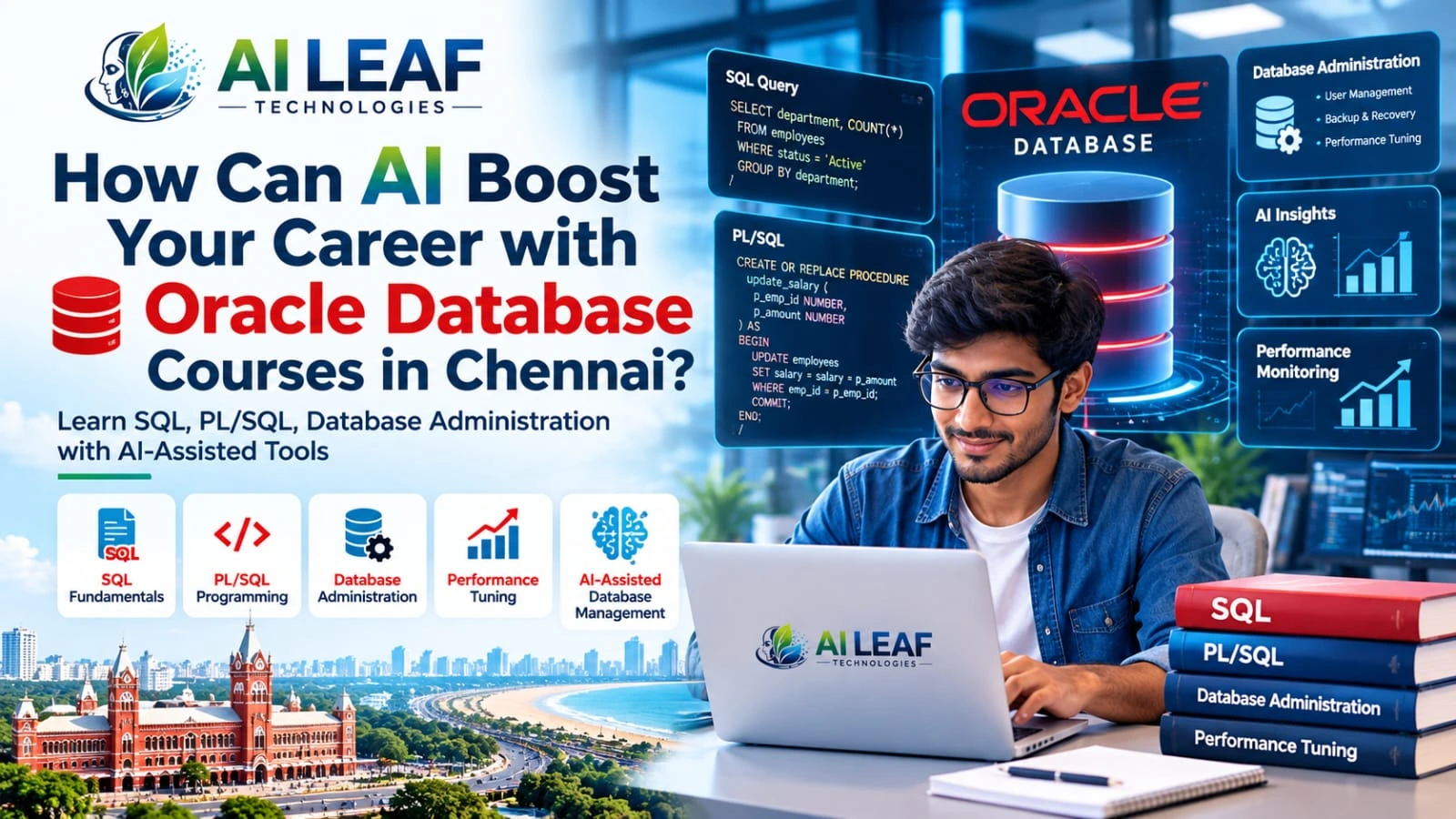
How Can AI Boost Your Career with Oracle Database Courses in Chennai?
Table of Contents
- Why Database Skills Still Matter
- What Is Oracle Database?
- How AI Is Changing Database Work
- Important Skills to Learn
- Practical Projects for Beginners
- Problems Beginners Commonly Face
- Career Opportunities
- How to Select the Right Training
- Explore AI Leaf Technologies
- Conclusion
- Frequently Asked Questions
𝗛𝗢𝗪 𝗖𝗔𝗡 𝗔𝗜 𝗕𝗢𝗢𝗦𝗧 𝗬𝗢𝗨𝗥 𝗖𝗔𝗥𝗘𝗘𝗥 𝗪𝗜𝗧𝗛 𝗢𝗥𝗔𝗖𝗟𝗘 𝗗𝗔𝗧𝗔𝗕𝗔𝗦𝗘 𝗖𝗢𝗨𝗥𝗦𝗘𝗦 𝗜𝗡 𝗖𝗛𝗘𝗡𝗡𝗔𝗜?
A business can have thousands of customer records, sales transactions and financial entries, but that information is useful only when it can be stored, retrieved and managed correctly. A slow query can delay a report, while a poorly designed database may create unnecessary maintenance work.
These challenges explain why database knowledge continues to matter across industries such as banking, healthcare, retail, logistics and information technology.
Artificial intelligence is also influencing how developers write queries, investigate errors and understand database performance. However, using AI effectively requires a sound understanding of SQL, data structures and security.
Oracle Database Courses in Chennai are worth exploring if you want to build these technical foundations and understand how enterprise databases support everyday business operations. The right learning path should combine database concepts, practical exercises and an introduction to relevant AI-assisted tools.
𝗪𝗛𝗬 𝗗𝗔𝗧𝗔𝗕𝗔𝗦𝗘 𝗦𝗞𝗜𝗟𝗟𝗦 𝗦𝗧𝗜𝗟𝗟 𝗠𝗔𝗧𝗧𝗘𝗥
Imagine a retail company processing orders through its website. Its team needs accurate stock information, reliable payment records and reports showing which products are performing well.
Without a well-managed database, employees may encounter outdated information, duplicate records or delays when retrieving important details.
Database professionals help organise information, maintain data integrity, control access and improve query performance. Their work supports applications that depend on accurate and available information.
As organisations adopt cloud platforms and AI-powered applications, the ability to manage underlying data remains essential. AI-generated answers are not automatically reliable if the source data is incomplete or the database query is incorrect.
For beginners, this creates a practical learning opportunity: understand how databases work before moving towards automation and advanced optimisation.
𝗪𝗛𝗔𝗧 𝗜𝗦 𝗢𝗥𝗔𝗖𝗟𝗘 𝗗𝗔𝗧𝗔𝗕𝗔𝗦𝗘?
Oracle Database is a relational database management system used to store, organise and retrieve structured information. It supports SQL for working with data and offers additional capabilities for administration, security, availability and performance management.
For example, a hospital management application may use database tables to maintain appointment details, billing information and authorised patient records. Appropriate database design and access controls help keep these records organised and protected.
Oracle database technology is used in a variety of enterprise environments. The exact features available depend on the product edition, version, deployment model and organisational configuration.
Official product information is available here:
𝗛𝗢𝗪 𝗔𝗜 𝗜𝗦 𝗖𝗛𝗔𝗡𝗚𝗜𝗡𝗚 𝗗𝗔𝗧𝗔𝗕𝗔𝗦𝗘 𝗪𝗢𝗥𝗞
AI is becoming relevant to database development and administration in several ways.
AI-assisted SQL development
AI tools can suggest SQL queries from plain-language instructions. Developers still need to check table relationships, filtering conditions, output accuracy and execution behaviour.
Query troubleshooting
When a query produces an error or runs slowly, AI assistants may help explain the syntax or suggest areas to investigate. Actual performance must be measured in the target environment.
Database monitoring and analysis
Database monitoring tools can provide information about resource usage, query execution and system activity. Some environments include intelligent analysis capabilities that help teams investigate performance concerns.
Automation support
Scripts and approved automation tools can assist with repetitive administrative tasks. Database changes should follow appropriate access controls, testing procedures and recovery plans.
AI application integration
Applications that use AI often retrieve information from databases. Developers must consider data permissions, privacy, accuracy and the way retrieved information is passed to AI systems.
AI can make certain tasks easier, but it does not remove the need for database fundamentals. Understanding the underlying system helps professionals evaluate recommendations rather than accepting them blindly.
𝗜𝗠𝗣𝗢𝗥𝗧𝗔𝗡𝗧 𝗦𝗞𝗜𝗟𝗟𝗦 𝗧𝗢 𝗟𝗘𝗔𝗥𝗡
A practical Oracle learning plan should introduce the basics before moving towards administration and performance optimisation.
1. SQL fundamentals
Learn SELECT statements, filtering, sorting, joins, grouping, subqueries and aggregate functions. These skills help you retrieve meaningful information from relational tables.
2. Database design
Understand tables, primary keys, foreign keys, relationships and constraints. Good design helps reduce unnecessary duplication and maintain consistency.
3. PL/SQL programming
Explore Oracle’s procedural extension to SQL. Learn variables, conditional statements, loops, procedures, functions and exception handling as your skills develop.
4. Oracle database administration
Study user management, permissions, database configuration, backup concepts and recovery fundamentals. The depth required depends on whether you want a developer or administrator role.
5. Performance tuning
Learn how to examine query execution plans, recognise inefficient SQL and investigate indexing choices. Test improvements with suitable sample data rather than relying on assumptions.
6. Security and AI awareness
Understand least-privilege access, sensitive-data handling and safe use of AI assistants. Avoid submitting confidential database records to unapproved tools.
Learners can also explore the official Oracle documentation to understand the features available in the version they are studying.
𝗣𝗥𝗔𝗖𝗧𝗜𝗖𝗔𝗟 𝗣𝗥𝗢𝗝𝗘𝗖𝗧𝗦 𝗙𝗢𝗥 𝗕𝗘𝗚𝗜𝗡𝗡𝗘𝗥𝗦
Projects help turn theoretical knowledge into demonstrable skills.
Project 1: Student records database
Create tables for students, courses and enrolments. Practise joins and queries to identify course registrations and calculate student counts.
Project 2: Inventory management system
Build sample product and stock tables. Write queries to identify low-stock items, summarise product categories and generate basic reports.
Project 3: Sales analysis dashboard dataset
Organise fictional order records and calculate monthly revenue, product totals and customer order counts. Prepare clean query outputs for use in a reporting tool.
Project 4: SQL performance investigation
Use a sample dataset to compare alternative query approaches. Review execution plans where supported and document any measured differences.
Project 5: AI-assisted SQL review
Ask an approved AI assistant to suggest a query for a sample business question. Test the result against known records and explain any corrections needed.
Document each project’s objective, database structure, queries and results. Use fictional or authorised data, especially when experimenting with AI tools. A clear portfolio can help you explain your technical decisions during interviews.
𝗣𝗥𝗢𝗕𝗟𝗘𝗠𝗦 𝗕𝗘𝗚𝗜𝗡𝗡𝗘𝗥𝗦 𝗖𝗢𝗠𝗠𝗢𝗡𝗟𝗬 𝗙𝗔𝗖𝗘
Difficulty understanding SQL joins
Different joins can be confusing when several tables contain related information.
Solution: Practise with small tables first. Draw the relationships between them and check the output before adding more complex conditions.
Queries return unexpected results
A query may execute successfully but still produce incorrect totals because of duplicate rows, missing filters or unsuitable joins.
Solution: Test the query against a small dataset with known results. Check the joins, conditions and grouping rules before using it for reporting.
Database administration feels overwhelming
Administration includes multiple responsibilities, from user permissions to backup and recovery.
Solution: Learn the purpose of each task separately, practise in a controlled environment and follow documented procedures.
AI-generated queries create confusion
A generated query may use incorrect column names or assumptions about the database structure.
Solution: Compare the query with the actual schema, test it using non-sensitive sample data and understand every important statement before using it.
Uncertainty about career direction
SQL development and database administration overlap, but they involve different priorities.
Solution: Explore both through small projects and compare them with the skills listed in current job descriptions.
𝗖𝗔𝗥𝗘𝗘𝗥 𝗢𝗣𝗣𝗢𝗥𝗧𝗨𝗡𝗜𝗧𝗜𝗘𝗦
Oracle database knowledge can support several technology career paths, depending on your practical ability and additional experience.
SQL Developer: Writes queries, develops database objects and supports data-related application requirements.
Oracle PL/SQL Developer: Builds procedures, functions and other database-side programming components.
Database Administrator: Helps manage database availability, permissions, backups, recovery and system performance.
Database Support Engineer: Investigates database issues and assists with troubleshooting and operational support.
Data or Reporting Analyst: Uses SQL to retrieve, organise and analyse information for business reporting.
Each role has different requirements. Some positions expect hands-on Oracle experience, Linux knowledge, cloud familiarity or additional programming skills.
Freshers can start by strengthening SQL, practising database design and building projects that demonstrate their understanding. Course completion alone does not guarantee employment; hiring decisions depend on the role and the candidate’s demonstrated skills.
𝗛𝗢𝗪 𝗧𝗢 𝗦𝗘𝗟𝗘𝗖𝗧 𝗧𝗛𝗘 𝗥𝗜𝗚𝗛𝗧 𝗧𝗥𝗔𝗜𝗡𝗜𝗡𝗚
Before enrolling, review what the programme actually teaches.
Inspect the syllabus: Check SQL, database design, PL/SQL, administration or performance tuning according to your career goal.
Confirm practical access: Ask whether you can run queries, create database objects and complete exercises independently.
Understand the AI component: Find out whether AI-assisted query development or troubleshooting is included and how results are validated.
Check the learning format: Compare schedules, teaching methods, duration, fees and available practice resources.
Review project support: Ask whether your work receives feedback and whether you can build a portfolio during training.
Clarify career services: Check what resume support, interview preparation or placement assistance is available. Ask for clear details instead of assuming a job is guaranteed.
A suitable course should match your current skill level and provide a realistic path towards the work you want to perform.
𝗘𝗫𝗣𝗟𝗢𝗥𝗘 𝗔𝗜 𝗟𝗘𝗔𝗙 𝗧𝗘𝗖𝗛𝗡𝗢𝗟𝗢𝗚𝗜𝗘𝗦
If you are comparing technology training providers, AI Leaf Technologies is one option to investigate. Request the latest Oracle-related course information, if available, and confirm the syllabus, practical exercises, trainer support and learning outcomes before enrolling.
Beginners should check whether the programme explains SQL and relational database concepts before introducing advanced topics. Learners with previous experience may prefer a course that provides deeper exercises in PL/SQL, administration or performance tuning.
Review the available training options here:
𝗖𝗢𝗡𝗖𝗟𝗨𝗦𝗜𝗢𝗡
Reliable databases remain important because businesses depend on accurate information for applications, reporting and everyday operations. AI is adding new ways to assist with query development and technical analysis, but database knowledge is still essential for checking results and protecting information.
By learning SQL, database design, PL/SQL and relevant administration concepts, you can build a foundation for exploring Oracle-related technology roles. Practical projects can help you understand how the concepts work together and demonstrate your skills to potential employers.
When comparing training options in Chennai, focus on hands-on practice, clear explanations and a syllabus that matches your goals. Start with the basics, test your knowledge through projects and gradually progress towards more advanced database work.
Frequently Asked Questions
1. What are Oracle Database Courses in Chennai?
These programmes may teach SQL, database design, PL/SQL, administration and performance concepts, depending on the syllabus.
2. Can beginners learn Oracle Database?
Yes. Beginners can start with relational database concepts and SQL before progressing to PL/SQL and administration topics.
3. How is AI used in database management?
AI-assisted tools may help suggest SQL queries, explain errors and support selected analysis tasks. Generated results must be validated.
4. What is the difference between SQL and PL/SQL?
SQL retrieves and manipulates relational data, while PL/SQL adds procedural programming features such as variables, conditions and exception handling in Oracle environments.
5. What projects can beginners build?
Beginners can create student records, inventory databases, sales analysis queries and small SQL performance investigations using sample data.
6. What jobs use Oracle database skills?
Relevant roles may include SQL Developer, PL/SQL Developer, Database Administrator, Database Support Engineer and Reporting Analyst.
7. Does completing a database course guarantee a job?
No. Employment depends on practical ability, relevant experience, interview performance and employer requirements.
8. What should I check before enrolling?
Review the syllabus, practical access, trainer support, project work, fees and any clearly defined career assistance.