
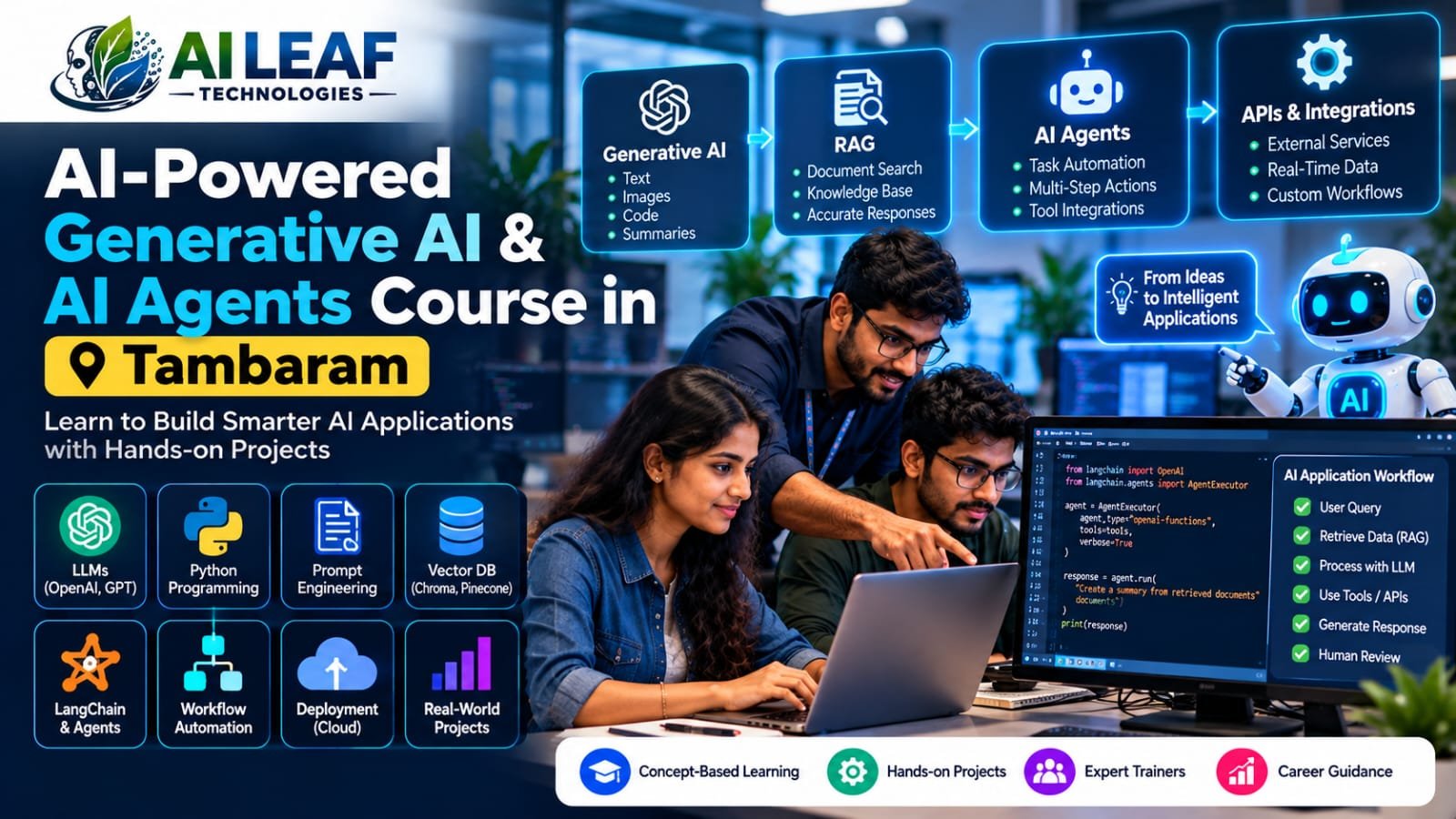
AI-Powered Generative AI & AI Agents Course in Tambaram: Skills for Building Smarter AI Apps
INTRODUCTION
Imagine a company that receives enquiries through its website, email and social media pages. Employees must identify the purpose of each message, find the relevant information and decide what should happen next. An AI application could help organise those enquiries, prepare draft replies and direct complicated requests to the appropriate person.
Developing such a system involves more than entering instructions into a chatbot. The developer must decide what information the application can access, connect the required services, test its responses and prevent it from taking actions beyond its permissions.
An AI-Powered Generative AI & AI Agents Course in Tambaram is worth evaluating if you want to explore this type of application development. The most useful learning experience should help you understand how individual components work together, where errors can occur and how to improve a system after testing it.
UNDERSTANDING GENERATIVE AI
Generative AI describes technology that produces content from a user’s instructions and the context available to the system. Depending on the model, the output may be written text, computer code, summaries, images or other supported material.
Consider an online store with hundreds of product descriptions. A generative AI application could prepare shorter descriptions using information supplied by the business. An employee could then review the draft before publishing it. The model helps with the task, while the business remains responsible for the accuracy of its product information.
Large language models, commonly known as LLMs, are widely used for language-related applications. They can summarise documents, interpret questions and generate responses. However, fluent output is not proof of factual accuracy. Applications that handle important information need suitable references, verification procedures and a way to communicate uncertainty.
For learners, the important step is understanding how to turn a model’s capabilities into a useful application rather than relying on the model by itself.
HOW AI AGENTS WORK
An AI agent is a system that uses a model, instructions and permitted tools to work towards a defined objective. Depending on its design, it may retrieve information, call an external service, examine the result and select a subsequent action.
For example, an internal support assistant might identify the subject of an employee’s question, search an approved knowledge base and prepare a response containing relevant information. If the request involves confidential records or a sensitive decision, the workflow can send it to a human reviewer.
An agent should not automatically be the answer to every automation problem. A fixed sequence of steps may be easier to test and maintain when the task is predictable. An agent-based approach may be useful when the system must choose between several permitted actions.
Understanding this difference is valuable in AI agent development training in Chennai, where learners may want to build systems that do more than produce a single text response.
SKILLS FOR BUILDING AI APPLICATIONS
Prompt Design and Output Control
A prompt needs to explain the task, provide the relevant context and describe the expected result. Vague instructions can produce inconsistent answers, while clear constraints make evaluation easier.
Practise giving the model a defined role, a specific task and an output structure. For instance, a customer-message classifier might be instructed to return only a category, a short reason and a recommended next step.
Do not judge a prompt using just one successful response. Prepare a collection of sample inputs, including incomplete and confusing requests, and examine how consistently the application follows the instructions.
Programming and API Integration
An application programming interface, or API, allows one software service to communicate with another. A developer might use an API to send a question to a language model and receive a generated response inside a website.
To implement this safely, learners should understand request formats, response handling, authentication, error messages and usage limits. They should also learn how an application behaves when a service becomes unavailable or returns an unexpected result.
API credentials require special care. Store them securely on the server side and keep them out of public repositories and browser code. These fundamentals are important when studying LLM application development or building software that uses external AI services.
Working with Documents and Retrieved Information
A model’s built-in knowledge may not include a company’s latest policies, internal documents or current course details. Retrieval-augmented generation, usually shortened to RAG, helps an application retrieve relevant material from an external information collection before preparing a response.
A training-centre assistant, for example, could search approved documents about courses, schedules and enrolment requirements. It could then draft an answer using the retrieved information.
A well-designed system should handle missing evidence properly. When its source material does not answer a question, it should say so instead of inventing a fee, date or policy. Access restrictions are also necessary when different users are allowed to view different documents.
Designing Controlled Agent Workflows
A workflow defines the sequence of operations an application may perform. It can include collecting information, checking required fields, retrieving records, preparing a draft and asking for approval.
Start by separating the task into smaller steps. Specify the information each step receives, the result it should produce and what happens when an operation fails.
For sensitive activities, such as changing a customer record or sending an important message, add appropriate confirmation and human review. An AI model should not receive unrestricted access to business systems simply because it can request actions.
Testing, Evaluation and Debugging
AI applications can respond differently to similar questions. A feature that appears successful during a demonstration may fail when users provide incomplete information, unexpected wording or conflicting instructions.
Create a test set containing normal requests, edge cases and deliberately confusing inputs. Check whether responses are relevant, supported by available information and formatted correctly. Also record response time, usage costs and failures.
When the application produces an incorrect result, investigate the cause rather than changing the prompt blindly. The issue may come from poor source documents, retrieval settings, programming logic or unclear instructions.
This practical evaluation process is a central part of responsible generative AI training in Tambaram.
PRACTICAL PROJECT IDEAS
A finished project gives you a way to demonstrate how you apply technical concepts. Choose a problem with a clear purpose and build only the features needed to solve it.
Project One: Document-Based Information Assistant
Create a small application that answers questions using a collection of approved documents. The system should retrieve relevant passages, prepare a response and show the supporting sources when possible.
Test questions that the documents cannot answer. The application should communicate the limitation rather than make up information. This project introduces document processing, retrieval, model integration and answer verification.
Project Two: Customer Enquiry Sorting Tool
Prepare a sample collection of customer messages and label them by subject, such as billing, product information or technical support. Build an application that predicts the appropriate category and recommends a next step.
Compare its results with your original labels. Review incorrect classifications and identify which types of messages require human attention. This exercise provides a practical introduction to AI automation training.
Project Three: Multi-Step Report Assistant
Develop a controlled tool that accepts structured sample information, checks for missing fields and prepares a draft report. Add validation rules before the final output is created.
Record the steps performed, the errors encountered and the corrections made. Keep approval with a human whenever the report could influence an important decision.
For every project, document the problem, the design choices, the tests performed and the limitations discovered. Use invented or authorised data instead of exposing private customer information.
SECURITY AND RESPONSIBLE AI
A useful AI application must protect information as carefully as it generates responses. Weak permissions, unreliable sources and unchecked actions can turn a convenient feature into a business risk.
Begin by restricting access to the information and tools that the application actually needs. Separate ordinary requests from operations that require approval. Check user permissions before retrieving protected information, and avoid storing sensitive data unnecessarily.
Prompt injection is another risk. An instruction hidden inside a document or user message may attempt to make a system ignore its original rules. Treat retrieved content as information to assess, not as automatic permission to change system behaviour.
AI-generated answers should also be checked against trustworthy references when accuracy matters. Keep records of important workflow actions, review failures and test the application again when its model, prompts or source material changes.
These safeguards are not optional extras. They form part of building dependable AI-powered software.
CAREER OPPORTUNITIES AND PREPARATION
People who develop AI application skills may explore roles such as junior AI application developer, generative AI developer, automation developer or software developer. The suitability of each role depends on programming ability, project experience, qualifications and the employer’s requirements.
Some positions require strong Python skills, while others emphasise web development, API integration, cloud services or data handling. Read current job descriptions before deciding which technical areas to study in greater depth.
Prepare to explain at least one project from beginning to end. Describe the original problem, how information moved through the system, why you selected a particular approach and how you measured the results. Be ready to discuss errors and what you changed after discovering them.
A course certificate can document your learning, but it does not guarantee employment. Practical ability, communication, problem-solving and interview performance remain important.
CHOOSING A TRAINING PROGRAMME
Before joining an AI-Powered Generative AI & AI Agents Course in Tambaram, compare the actual learning activities rather than relying only on the course name.
Ask the institute these questions:
– Will students build working applications individually or mainly watch demonstrations?
– Does the syllabus include model APIs, document retrieval and controlled agent workflows?
– How are inaccurate responses tested and corrected?
– Are security, data privacy and tool permissions covered?
– Will learners receive feedback on code and project design?
– What are the current fees, duration, class timings and entry requirements?
– What career support is available, and what does it specifically include?
Request clear answers before making a payment. If a programme advertises placement assistance, ask whether it includes resume reviews, mock interviews or job referrals. Such support should not be interpreted as a guaranteed job offer.
You can review the available programmes on the AI Leaf Technologies website.
AI LEAF TECHNOLOGIES
AI Leaf Technologies lists an AI-Powered Generative AI & AI Agents programme among its training offerings. If the course matches your goals, ask the institute for its current syllabus and the exact amount of practical work included.
Find out which models and development tools are used, how learners integrate APIs, whether projects are tested against defined criteria and how security issues are addressed. Confirm individual modules directly instead of assuming every topic is covered in the same depth.
You can learn about the organisation here.
Before enrolling, confirm the latest course fee, duration, available learning formats, batch schedule and any career support offered. These details may change, so obtain the current information directly from the institute.
For course enquiries, contact the team through the official page.
CONCLUSION
Building an AI application involves much more than getting a model to produce a convincing answer. Developers must connect suitable information sources, control how tools are used, test the results and decide when a person needs to intervene.
When comparing training options in Tambaram, look for opportunities to develop a working application, investigate failures and explain the decisions behind your design. A carefully tested project can demonstrate what you have learned far more clearly than a list of technologies alone.
Choose a programme that matches your current ability, practise consistently and keep improving your projects through evidence-based testing. These habits provide a practical foundation for exploring generative AI and agent-based application development.
You can also visit the main website to review its current training information.
Frequently Asked Questions
What can I learn in an AI-Powered Generative AI & AI Agents Course in Tambaram?
Depending on the syllabus, learners may study prompt design, language models, API integration, document retrieval, agent workflows, application testing and responsible AI practices. Confirm the exact modules with the institute.
How are generative AI and AI agents different?
Generative AI produces outputs such as text or code. An AI agent combines a model with instructions and permitted tools to complete a defined task through a controlled workflow.
Is programming necessary for AI application development?
Programming is useful for connecting models to applications, handling data and controlling workflows. Check the course prerequisites to understand whether beginners can join directly.
What is retrieval-augmented generation?
Retrieval-augmented generation combines document or data retrieval with model-generated responses. It can help an application answer questions using relevant external information.
What projects can beginners create?
Possible projects include a document-based question-answering assistant, a customer enquiry classifier and a tool that prepares draft reports from structured information.
How can developers reduce AI errors?
They can use reliable sources, create test cases, check responses against expected results, restrict tool permissions and require human review for sensitive actions.
Does completing an AI course guarantee a job?
No. Employment depends on practical skills, project quality, qualifications, communication, interview performance and available opportunities.
What should I confirm before joining AI Leaf Technologies?
Ask for the current syllabus, project details, course fee, duration, batch timings, learning format and a clear explanation of any career assistance provided.